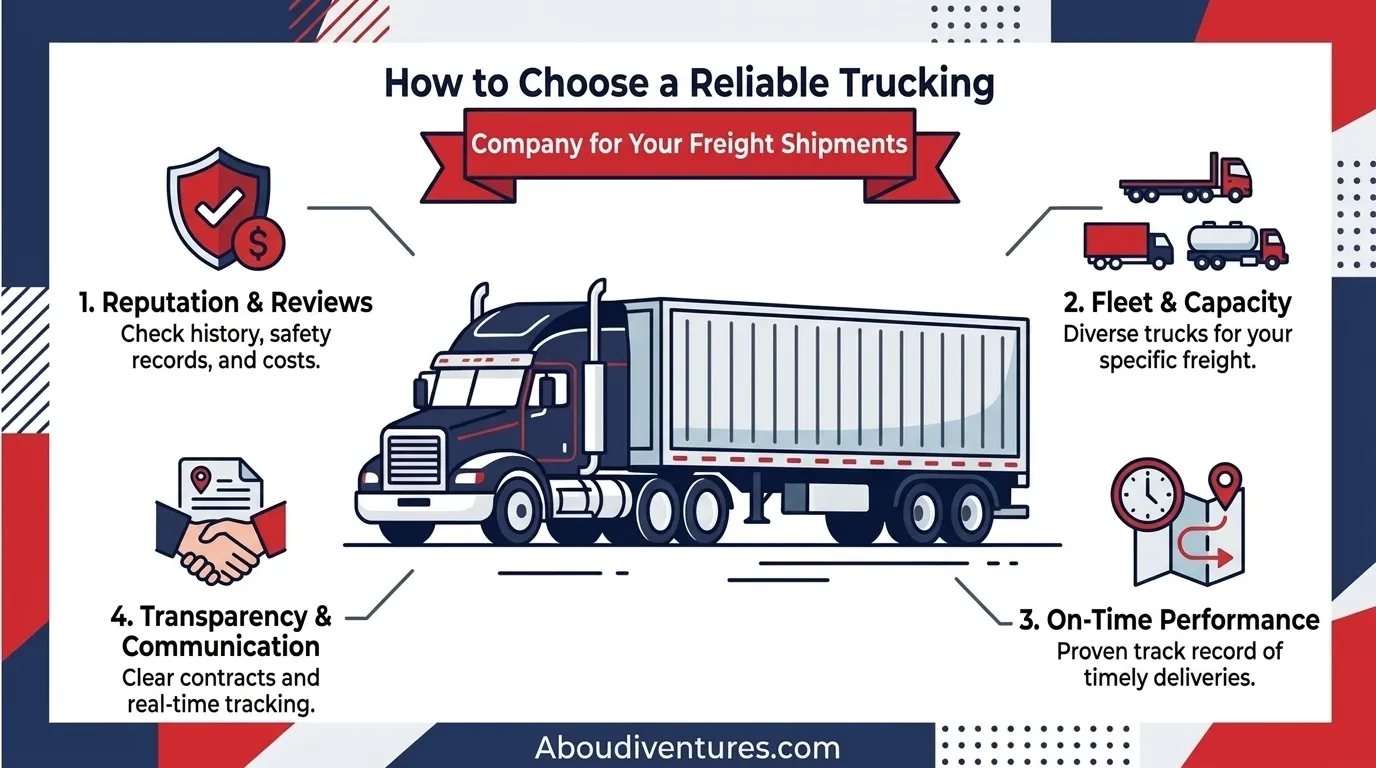
How to Choose a Reliable Trucking Company for Your Freight Shipments
Hiring a trucking company should be simple: get a quote, book the load, and expect it to show up on time. In practice, shippers are choosing from a pool of more than 2.2 million active FMCSA-registered motor carriers in the United States, and not every one of them is who they claim to be.
This guide breaks down exactly what to check, in what order, before you hand your freight to a carrier you have not worked with before, backed by 2026 industry data rather than generic advice.
Why the Right Trucking Partner Matters More Than the Price Tag
When a shipment gets delayed, damaged, or lost, the cost is rarely just financial. Late deliveries strain customer relationships, damaged freight triggers claims paperwork, and unreliable communication makes it impossible to plan around a delivery window.
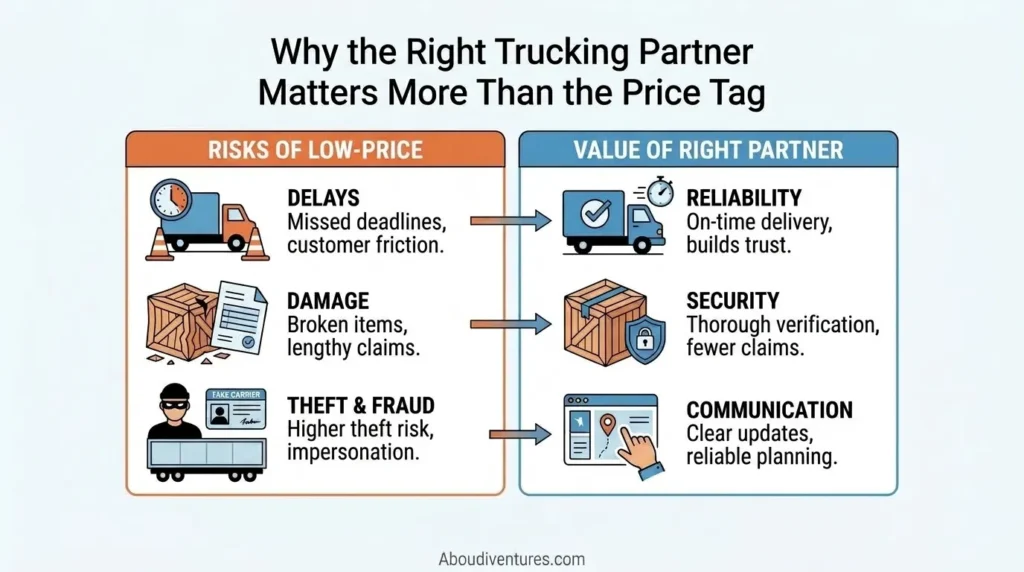
The stakes are bigger than most shippers realize: the National Insurance Crime Bureau puts total annual cargo theft losses across the United States at roughly 35 billion dollars, and Verisk CargoNet recorded losses of more than 300 million dollars in a single quarter of 2026 alone, even as the number of reported incidents fell. In other words, criminals are stealing less often but walking away with more each time, largely by posing as legitimate carriers rather than breaking into trailers.
This article walks through the exact factors that separate a dependable trucking company from a risky one, including the verification steps most shippers skip, so you can make a confident decision the next time you need freight moved.
Freight loss and fraud figures in this piece are drawn from public reporting by Verisk CargoNet, Overhaul’s 2026 U.S. Cargo Theft Report, and the American Transportation Research Institute.
Start With Licensing and Authority
Every legitimate carrier operating in interstate commerce needs an active USDOT number and, in most cases, an MC (Motor Carrier) number issued by the Federal Motor Carrier Safety Administration.
With more than 2.2 million active carriers on file nationwide, no single directory or review site can vouch for all of them, so verification has to happen on a company-by-company basis.
Before booking a load, ask for both numbers and verify them on the FMCSA’s public Safety and Fitness Electronic Records (SAFER) system. A carrier that hesitates to share this information, or whose authority shows as “revoked” or “not authorized,” is not one to work with.
Here is what an actual verification check should cover, not just a glance at the number:
- Operating status. Confirm the carrier shows “Active” rather than “Out of Service” or “Revoked.”
- Authority type. Check whether the carrier holds common, contract, or broker authority, since each type carries different obligations to you as a shipper.
- Insurance on file. SAFER shows whether cargo and liability insurance are currently on file, not just whether the carrier once had coverage.
- Fleet size and years in operation. A company with one truck and a registration from last month is not automatically a scam, but it does warrant more questions than one operating for a decade with a larger fleet.
- Safety rating and inspection history. Covered in more detail below.
At Aboudi Ventures LLC, our authority is registered under MC 1757911 and USDOT 4458409, both verifiable directly through FMCSA records. Sharing this openly is the first sign of a trucking company that has nothing to hide.
Freight Fraud and Broker Scams to Watch For in 2026
This is the gap most “how to choose a trucking company” guides leave out, and it is the fastest-growing risk in freight right now. According to ATRI’s cargo theft findings, strategic and cyber-enabled theft, meaning fraud through impersonation and forged paperwork rather than physical break-ins, now accounts for roughly one in four reported cargo thefts, and about two-thirds of surveyed motor carriers report having experienced at least one theft. The three patterns to know before you book a load:
- Double brokering. A carrier or an unlicensed party accepts your load, then secretly reassigns it to another, unvetted carrier without your knowledge. If something goes wrong, you may struggle to identify who actually had your freight.
- Identity cloning and fictitious pickups. Fraudsters copy a legitimate carrier’s DOT number, insurance certificate, and company name, then show up to collect a shipment that was never booked with them. Truckstop’s 2026 fraud reporting notes that these scams increasingly rely on business email compromise and spoofed contact details rather than obvious forgeries.
- Bait pricing and payment pressure. A rate that is unusually low, combined with pressure to book immediately without a rate confirmation, is a documented industry red flag rather than a coincidence.
How to protect your shipment: verify the carrier’s phone number and email domain against their FMCSA listing, insist on a written rate confirmation before the truck is dispatched, never wire money in response to an “overpayment,” and call the carrier directly through a number you looked up independently rather than one provided in an unsolicited message.
Check Insurance Coverage, Not Just Its Existence
Cargo insurance and liability insurance are not the same thing, and shippers often confuse the two. Cargo insurance covers the actual freight being hauled if it is damaged or lost in transit, while liability insurance covers accidents involving the truck.
A reliable carrier should be able to produce a certificate of insurance on request, showing coverage limits that match the value of what you are shipping. FMCSA’s minimum required cargo insurance for general freight carriers is commonly set well below the value of a full trailer load, so for high-value, temperature-sensitive, or hazardous freight, ask specifically what the per-shipment coverage limit is rather than assuming standard minimums are enough.
Evaluate Equipment and Fleet Condition
A carrier’s equipment tells you a lot about how it operates. Ask what type of trailers are available, whether that is a dry van, a reefer, or a flatbed, how old the fleet is, and how often trucks go through maintenance inspections.
Well-maintained equipment means fewer breakdowns, fewer delays, and lower risk of cargo damage from temperature swings or mechanical failure. If your freight has special requirements, such as refrigerated transport, confirm the carrier has dedicated reefer units rather than repurposed dry vans.
Review Safety Ratings and CSA BASIC Scores
Beyond a general “safety rating,” FMCSA’s Compliance, Safety, Accountability (CSA) program scores every carrier across seven behavior categories, known as BASICs: unsafe driving, hours-of-service compliance, driver fitness, controlled substances and alcohol, vehicle maintenance, hazardous materials compliance, and crash indicator.
A carrier with elevated scores in vehicle maintenance or hours-of-service compliance is statistically more likely to experience breakdowns, delays, or violations that hold up your freight at a roadside inspection.
These scores, along with full inspection and crash history, are publicly available through FMCSA’s SAFER system, so there is no reason to take a carrier’s word for its own safety performance.
The driver fitness BASIC in particular reflects how seriously a carrier takes licensing; see our guide on how to get a CDL in 7 steps for what that qualification process actually involves.
Ask About Communication and Tracking
One of the most common shipper complaints is not knowing where a load actually is. A dependable carrier gives you a direct point of contact, provides regular status updates, and can answer questions about pickup and delivery windows without long delays.
Some carriers offer GPS-based tracking so you can check load status yourself rather than waiting on a phone call. Industry benchmarks put a strong on-time delivery rate at 95 percent or higher for business freight operations, so it is fair to ask a prospective carrier what their actual on-time performance looks like, not just whether they “usually” deliver on time.
Broker or Carrier: Know Who You Are Actually Hiring
A carrier physically owns or leases the trucks that move your freight. A broker does not own trucks; instead, it arranges transportation by connecting shippers with carriers, earning a margin on the transaction.
Both can be legitimate and both are regulated by FMCSA, but they carry different accountability. If your shipment is lost or damaged, the answer to “who is responsible” depends heavily on whether you contracted directly with the carrier or with a broker who then subcontracted the load.
Before signing anything, ask the company directly whether they are the broker, the carrier, or both, and get the actual carrier’s DOT number in writing if a broker is involved. This single question prevents most of the double-brokering disputes described above.
FTL or LTL: Match the Carrier to Your Shipment Type
Not every trucking company handles every kind of freight well. Some specialize in full truckload (FTL) shipments where one load occupies an entire trailer, while others focus on less-than-truckload (LTL) freight that shares space with other shipments.
If you regularly ship pallet-sized loads, an LTL specialist may offer better rates. If you move large or time-sensitive freight, an FTL carrier gives you more control over pickup and delivery timing.
For urgent, smaller loads that cannot wait for space to open up, ask whether the carrier also offers hotshot service; our complete guide to hotshot trucking covers how it compares on speed and cost.
To see the full range of equipment and shipment types a carrier should be able to support, check our freight shipping services page.
Quick Reference: Verification Checklist
| Factor | Warning Sign | Sign of Reliability |
|---|---|---|
| Authority | Cannot provide MC or USDOT number, or status shows revoked | Numbers verifiable as Active on FMCSA SAFER |
| Fraud risk | Pressure to book without a rate confirmation, phone or email that does not match FMCSA listing | Willing to confirm details through channels you look up independently |
| Insurance | Vague or unwilling to share certificate | Provides certificate with clear, shipment-matched coverage limits |
| Safety scores | High BASIC scores in maintenance or hours-of-service, thin or hidden inspection history | Scores and history openly available and within normal range on SAFER |
| Equipment | No details on trailer type or age | Specific, well-maintained fleet matched to freight type |
| Broker or carrier | Unclear who physically holds the freight | States plainly whether they are broker, carrier, or both, with the carrier’s DOT number available |
| Communication | Slow or inconsistent updates | Direct contact, proactive status updates, real on-time delivery data |
| Pricing | Rate far below every other quote you received | Transparent, itemized quote in line with current market rates |
A Rate That Seems Too Good Is Usually a Red Flag
Freight rates fluctuate based on fuel prices, distance, freight type, and current market demand. A quote that comes in dramatically lower than every other carrier you have contacted is worth questioning rather than celebrating.
Cargo theft analysts have found that the average stolen shipment in 2026 was worth well over 300,000 dollars, and unusually aggressive pricing is one of the documented tactics fraud rings use to get freight assigned to them quickly, before a shipper has time to verify credentials.
A rate that undercuts the market can also simply signal a carrier cutting corners on insurance, using subpar equipment, or planning to add unexpected fees later.
Compare any quote against a carrier’s stated freight shipping services and equipment list so you can spot an unrealistic quote before it becomes a problem.
Read Reviews, But Verify Safety Records Too
Online reviews give a general sense of customer satisfaction, but they don’t always reflect a carrier’s actual safety performance. FMCSA’s Safety Measurement System scores carriers on categories like unsafe driving, crash history, and hours-of-service compliance.
Cross-referencing customer reviews with these official safety scores, and with a quick search for “[company name] complaints” on the Better Business Bureau, gives a much fuller picture than either source alone.
Frequently Asked Questions
How do I verify a trucking company’s USDOT number?
You can look up any carrier’s USDOT and MC number directly through the FMCSA’s Safety and Fitness Electronic Records (SAFER) system, which shows active authority status, insurance on file, and safety ratings.
What’s the difference between a broker and a carrier?
A carrier physically owns or leases the trucks that move your freight. A broker arranges transportation by connecting shippers with carriers but does not own trucks. Both can be legitimate, but it matters to know which one you’re working with, since accountability for the shipment differs.
What is double brokering, and why does it matter to me as a shipper?
Double brokering happens when the carrier or broker you hired secretly hands your load off to another, unvetted party without telling you. If that unknown party damages or loses the freight, tracing responsibility and filing a claim becomes far more difficult.
Should I always choose the cheapest trucking quote?
Not necessarily. The cheapest quote sometimes reflects a carrier cutting costs on insurance, maintenance, or driver pay, all of which increase your risk of delays or damaged freight, and unusually low rates are also a documented tactic in freight fraud. Compare quotes alongside safety records and equipment quality, not price alone.
Is it normal for a trucking company to ask for upfront payment or a wire transfer?
Be cautious here. Legitimate carriers and brokers typically work off signed rate confirmations and standard payment terms. Requests to wire money quickly, refund an “overpayment,” or pay through untraceable methods are recognized red flags in current freight fraud reporting.
How far in advance should I book a truckload?
For standard freight, booking three to five business days ahead generally secures better rates and equipment availability. Peak seasons, including the holiday stretch from Labor Day through December, which cargo theft trackers flag as higher risk windows, or specialized equipment needs may require booking one to two weeks out.
Ready to Ship With a Carrier You Can Verify
Aboudi Ventures LLC operates under MC 1757911 and USDOT 4458409, with a fleet maintained for reliable, on-time freight delivery. If you’re evaluating carriers for an upcoming shipment, reach out to our team at aboudiventures@gmail.com for a transparent quote and direct answers to your questions before you book.
Looking to drive for a carrier instead of ship with one? We’re hiring — browse open positions on our careers page.