How to Get Your CDL: 7 Steps From Permit to Your First Trucking Job
Every year, thousands of people decide to leave behind a job that isn’t paying off and start a trucking career instead. The pull is obvious: no four-year degree, six-figure earning potential in some lanes, and a genuine shortage of qualified drivers. But almost every guide on “how to get a CDL” stops at the parking lot of the DMV, right after you pass your skills test. It never answers the question you actually care about: now what?
This guide walks through all 7 steps, including the one everyone else skips: what it actually takes to get hired once your license is in hand.
What Is a CDL, and Do You Actually Need One?
A Commercial Driver’s License (CDL) is required to legally operate a commercial motor vehicle (CMV). Generally, that means anything over 26,001 lbs GVWR, any vehicle towing a trailer heavier than 10,000 lbs, or vehicles carrying 16+ passengers or hazardous materials. If you’re driving a straight truck or box van under that weight threshold, you may not need one at all, which is worth confirming before you spend a dime on training.
Step 1: Confirm You Meet the Basic Requirements
Before you spend money on anything, make sure you qualify. Most states require:
- You’re at least 18 years old for intrastate (in-state only) driving, or 21 to cross state lines or haul hazardous materials
- You hold a valid, non-CDL driver’s license
- You have a reasonably clean driving record (multiple DUIs, license suspensions, or certain felony convictions can disqualify you)
- You can pass a DOT physical and a background check
This is also where you should decide which CDL class fits your goals: Class A (tractor-trailers), Class B (straight trucks, buses), or Class C (small hazmat or passenger vehicles). Most over-the-road trucking jobs, and the higher pay that comes with them, require a Class A.
Step 2: Get Your DOT Medical Certificate
This step gets buried in most guides, but it can quietly disqualify people who assumed they were fine. You’ll need an exam from a medical examiner listed on the National Registry of Certified Medical Examiners to confirm you’re physically qualified to operate a CMV. Conditions like uncontrolled diabetes, certain heart conditions, sleep apnea, or vision or hearing issues can require additional testing or a waiver, so it’s worth getting this exam early, before you’ve paid for a training program, rather than after.
Step 3: Study for and Pass Your CLP Knowledge Tests
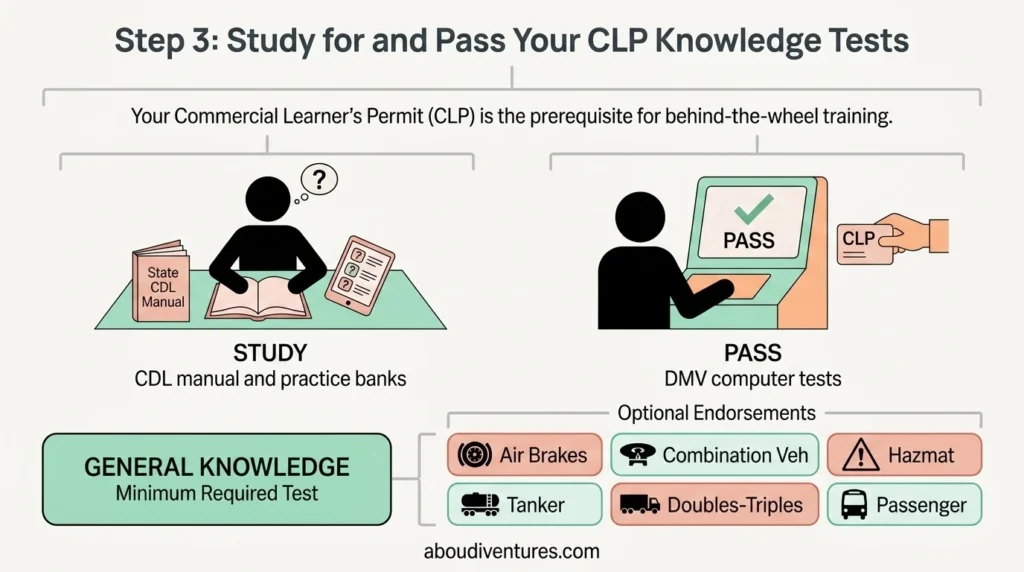
Your Commercial Learner’s Permit (CLP) is the prerequisite for behind-the-wheel training. To get it, you’ll study your state’s CDL manual and pass a written knowledge test at your local DMV: the General Knowledge test at minimum, plus additional tests for Air Brakes, Combination Vehicles, or any endorsements (Hazmat, Tanker, Doubles-Triples, Passenger) you want. Most people underestimate this step; treat it like a real exam, not a formality. Question banks and practice tests specific to your state manual make a real difference here.
Step 4: Complete FMCSA-Approved Entry-Level Driver Training (ELDT)
Since 2022, this step is federally required, not optional, a detail a surprising number of articles still skip. If you’re applying for a Class A or B CDL for the first time, upgrading, or adding a Hazmat, Passenger, or School Bus endorsement, you must complete training through a school listed on the FMCSA Training Provider Registry (TPR). Training not on the registry won’t count, even if it’s thorough, so confirm accreditation before you enroll anywhere.
You have real choices here, and they trade off differently:
- Private CDL schools: Typically $3,000–$10,000, 4–8 weeks, and you pay upfront.
- Community college programs: Often cheaper ($1,000–$6,000) but may run longer.
- Company-sponsored paid training: Some carriers pay you a stipend during training (often $500–$700/week) in exchange for a service commitment afterward, sometimes 6–12 months. Read the contract carefully. Leaving early usually means repaying tuition, sometimes several thousand dollars.
CDL School: Cost, Timeline, and the Permit Test Explained
Since these three questions come up constantly once someone starts comparing schools, they’re worth breaking out on their own.
How Long Does CDL School Take?
Most full-time CDL programs take 3 to 8 weeks, typically Monday through Friday, 6-8 hours a day. Community college programs that meet part-time or in the evenings usually stretch to 2-3 months since the total training hours are the same, just spread out over more weeks.
A few things push your timeline longer than average: needing extra behind-the-wheel practice before you’re test-ready, retaking any part of the skills test, or waiting on scheduling backlogs at busy testing sites.
If you’re comparing schools, ask directly how many students finish on the advertised timeline versus how many need extra weeks. It’s a more honest number than the brochure figure.
The CDL Permit Test (CLP), Explained
The CLP test is the first real hurdle, and it’s where most first-time applicants underestimate the workload. It’s a written, multiple-choice knowledge test taken at your local DMV or licensing office, not a driving test. You’ll need to pass:
- The General Knowledge test (required for every CDL applicant)
- The Air Brakes test (required if the vehicle you’ll drive or test in has air brakes, which most do)
- The Combination Vehicles test (required for Class A, since you’ll be pulling a trailer)
- Any endorsement tests (Hazmat, Tanker, Passenger, School Bus, Doubles-Triples) for extras you want now
Each test is state-administered, so the exact question count and passing score vary, but 80% is a common minimum.
Most states let you retake a failed section after a short waiting period (often the same day or next business day) for a small fee, so a first attempt isn’t the end of the world, but showing up prepared saves you both time and money.
Free state-specific practice tests based on your CDL manual are the most efficient way to study; generic online quizzes that aren’t matched to your state’s manual can leave gaps.
CDL School Cost in 2026
Total cost depends heavily on the training path you choose:
| Training Path | Typical Cost | Typical Length |
|---|---|---|
| Community college program | $1,000 – $6,000 | 6 – 12 weeks |
| Private CDL school | $3,000 – $10,000 | 4 – 8 weeks |
| Company-sponsored paid training | $0 upfront (service commitment required) | 3 – 6 weeks |
On top of tuition, budget for the DOT physical ($50–$150), CLP and knowledge test fees ($5–$50 per attempt), the skills test ($30–$250, varies widely by state), and the CDL issuance fee itself ($30–$125).
Altogether, most drivers land somewhere between $4,000 and $12,000 all-in for a traditional (non-sponsored) path in 2026, with company-paid training remaining the lowest out-of-pocket option if you’re comfortable with the post-training work commitment it usually requires.
Step 5: Pass the CDL Skills Test
This is the test that actually earns you the license, and it has three parts, all of which you must pass:
- Vehicle inspection: walk an examiner through a pre-trip inspection, explaining what you’re checking and why
- Basic controls test: maneuvers like backing, alley docking, and parallel parking in a confined space
- Road test: driving in real traffic conditions with an examiner grading your decisions
If you fail one section, most states delay the rest of your testing and charge a retest fee. You typically get up to three attempts, so pace your practice accordingly rather than rushing to test day.
Step 6: Get Your CDL and Choose Your Endorsements Wisely
Once you pass, you’ll surrender your CLP and receive your CDL, along with any endorsements you tested for.
Don’t skip endorsements to save a little time now. Going back for a Hazmat or Tanker endorsement later means another test (and for Hazmat, TSA fingerprinting and a background check).
If there’s a decent chance you’ll want it eventually, testing for it now is almost always cheaper in total time and money.
Step 7: Get Hired (The Step Most Guides Leave Out)
A license doesn’t equal a job offer, and this is where a lot of new drivers get stuck. Most carriers, understandably, are cautious about first-time drivers with zero road experience. A few things make a real difference:
- Apply directly to carriers that hire new CDL holders, rather than only to job boards. Many won’t advertise entry-level openings publicly.
- Have a clean, honest MVR (motor vehicle record) and employment history ready. Carriers run background checks, and gaps or inconsistencies slow down onboarding more than most applicants expect.
- Consider a mentorship or trainer program for your first few months on the road. It builds the experience carriers want to see before handing over a truck solo.
- Decide early: company driver or owner-operator? Company driving gets you paid miles and less overhead risk while you build experience; owner-operator status offers more control and higher upside once you have a track record.
If you’re weighing your first move after licensing, Aboudi Ventures hires both new and experienced Class A drivers and welcomes owner-operators looking to lease on, running dry van, flatbed, refrigerated, and expedited freight across the lower 49 states.
Frequently Asked Questions
How much does it cost to get a Commercial driving license?
Total costs typically run $4,000–$12,000, covering training tuition, the DOT physical ($50–$150), knowledge and skills test fees, and licensing fees (often $30–$125 depending on the state). Company-sponsored paid training programs can reduce or eliminate the upfront cost in exchange for a post-training work commitment.
How long does it take to get a CDL?
Most full-time programs take 3–8 weeks. Part-time or evening programs can stretch to 2–3 months. Add a few extra weeks if you need to retake any portion of the skills test.
Can I get paid while getting my CDL?
Yes, some carriers offer paid, on-the-job training where you’re hired as an employee from day one and earn a weekly stipend during training. The tradeoff is usually a required service commitment (often 6–12 months) after you’re licensed.
What disqualifies you from getting a CDL?
Common disqualifiers include being under the minimum age, certain DUI or reckless driving convictions, an unresolved medical condition that fails the DOT physical, and, for interstate or hazmat driving, specific criminal history flagged in a background check. Many conditions (like sleep apnea) don’t disqualify you outright but require additional documentation or a waiver.
Do I need a CDL to drive a box truck?
Not always. If the vehicle’s GVWR is under 26,001 lbs and you’re not towing a heavy trailer or hauling hazmat or passengers, you likely don’t need a CDL. Check your specific vehicle’s weight rating to be sure.
What happens if I fail the CDL skills test?
You’re typically allowed up to three attempts, but you’ll pay a retest fee each time, and failing one section delays testing on the rest. Most people who fail do so on the vehicle inspection or backing maneuvers. Extra practice in those two areas before retesting is usually the fastest fix.
Is getting a CDL worth it?
For many drivers, yes. Starting salaries in trucking often range from $50,000–$95,000+ depending on the freight type, region, and whether you’re a company driver or owner-operator, with no four-year degree required. Like any career move, it depends on your tolerance for time on the road and the training path you choose.
Ready to put your new CDL to work? Explore driver and owner-operator opportunities with Aboudi Ventures, a licensed, DOT-compliant carrier (USDOT #4458409, MC #1757911) running full truckload, LTL, flatbed, and refrigerated freight across all 49 states. Or learn more about our company and the freight services our drivers move every day.