
Benefits of Intermodal Shipping: Cost, Fuel, Emissions, and Capacity
Intermodal shipping is the movement of freight in one container or trailer across two or more transport modes, usually truck and rail, without unloading the cargo at each transfer.
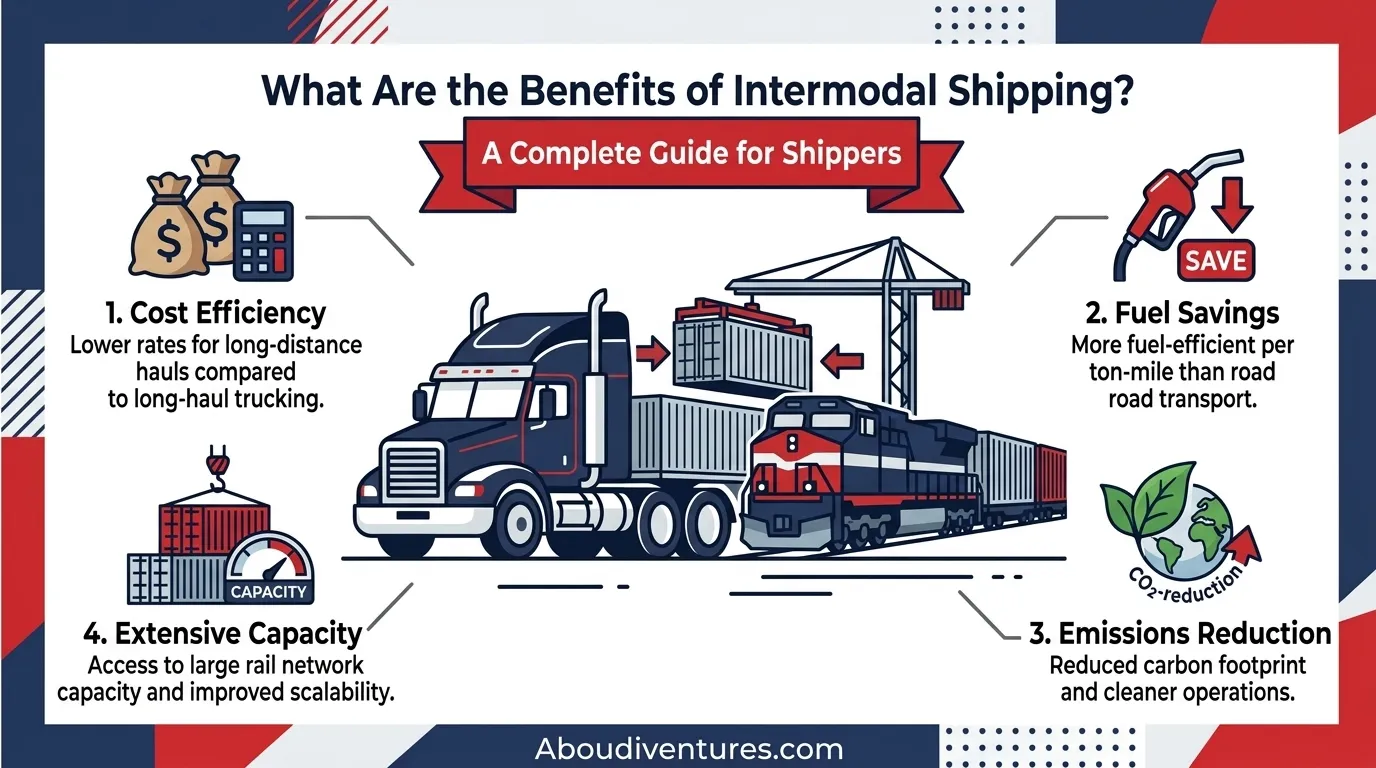
Its main benefits are lower cost on long lanes, better fuel efficiency, lower emissions, reliable capacity, and less highway congestion. This guide explains each benefit with current data and shows which freight fits intermodal.
How Does Intermodal Shipping Work
An intermodal move has three legs: first-mile drayage, a rail line haul, and last-mile drayage. A truck picks up the loaded container and takes it to a rail ramp. A train carries the container across the long-haul corridor. A second truck delivers it to the receiver.
Drayage is the short truck movement between a rail ramp or port and the shipper or receiver.
Drayage connects rail to the warehouse, so the trucking partner determines how well the whole move performs. You can see how we run those legs on our freight shipping services page.
Does Intermodal Shipping Lower Freight Costs?
Yes. Intermodal shipping usually costs 10 to 20 percent less than full truckload on lanes over 500 miles. The rail leg replaces the most expensive stretch of the truck move, which is long-haul driver time and diesel.
TLI analysts note that the gap becomes hard to ignore past 700 miles. Rail pricing also moves more slowly than truck pricing.
A recent Carrier Atlas market report found that van contract rates on the Harrisburg to Atlanta lane rose about 26 percent, while intermodal rates on the same lane rose about 16 percent. Slower rate growth gives shippers a steadier freight budget.
Is Intermodal Shipping More Fuel Efficient Than Trucking?
Yes. Freight rail moves one ton of freight about 473 miles on one gallon of fuel, while the average truck moves the same ton about 135 miles.
Rail is therefore roughly three to four times more fuel efficient than trucking. Fuel efficiency protects shippers when diesel prices climb, because the rail leg consumes far less diesel per ton-mile. Fuel surcharges on the truck legs also apply to only a small share of the total distance.
Does Intermodal Shipping Reduce Emissions?
Yes. EPA material reports that on shipments over 1,000 miles, intermodal cuts fuel use and greenhouse gas emissions by up to 65 percent compared with trucking alone.
Shippers with sustainability targets can lower freight emissions through intermodal without changing the product or the lane. Lower freight emissions also support Scope 3 reporting goals.
Is Intermodal Capacity More Reliable Than Truckload?
Yes. Intermodal reduces reliance on long-haul truck drivers, which helps stabilize costs. When truckload capacity tightens, rail capacity stays available because trains carry far more freight per crew than trucks.
Drayage drivers also complete more pickups and deliveries per day than long-haul drivers on multi-day trips, so equipment turns faster.
How Does Intermodal Shipping Reduce Highway Congestion?
One intermodal train takes about 280 trucks off the road, according to the Association of American Railroads. AAR also estimates that moving just 10 percent of long-haul freight to rail would save about 1 billion gallons of fuel each year. Fewer trucks on the interstate means less pavement wear and fewer delays for all drivers.
What Does Door-to-Door Intermodal Service Include?
Door-to-door intermodal service combines rail efficiency with trucking flexibility. Rail alone cannot reach a warehouse dock, so drayage providers and short-line railroads handle the first and last miles.
Coordination between these parties determines whether the shipment moves as one continuous service or as three disconnected handoffs.
Intermodal vs. Full Truckload
| Factor | Intermodal | Full Truckload |
|---|---|---|
| Best distance | 500 miles and up | Under 500 miles |
| Typical cost on long lanes | 10 to 20 percent lower | Higher |
| Transit time | Longer, more predictable | Faster |
| Fuel efficiency | 3 to 4 times better | Baseline |
| Best for | High-volume, non-urgent freight | Time-critical freight |
When Is Intermodal Shipping Not a Good Fit?
Intermodal shipping is a poor fit for urgent shipments, lanes under 500 miles, and small less-than-truckload freight. Terminal handoffs add time that urgent freight cannot absorb.
Short lanes lose the rail cost advantage because drayage makes up most of the distance. Small LTL freight incurs extra handling at each terminal, and that handling cancels out the savings.
How Do You Know If Your Freight Fits Intermodal?
Freight fits intermodal when three conditions are true: the lane runs 500 miles or more, the delivery window allows an extra day or more of transit, and the shipment moves in steady volume.
Containerized, non-perishable freight such as consumer goods, paper, packaged food, and retail inventory usually qualifies.
Oversized loads that need flatbed equipment usually stay on the truck. Shippers should also confirm that the origin and destination each sit close to a rail ramp. A ramp far from either dock raises drayage cost and shrinks the savings.
How Aboudi Ventures Supports Intermodal Moves
Aboudi Ventures runs its own trucks and drivers and also works with vetted third-party carriers. That combination covers first-mile pickups, final-mile deliveries, and overflow volume.
Our regional teams serve shippers across the Southeast, and our Alabama freight page lists the details. Ready to move freight? Send your lane details through our contact page, and our dispatch desk will respond with next steps.
Frequently Asked Questions (FAQs)
1. What is the main benefit of intermodal shipping?
Cost savings on long lanes. Intermodal typically runs 10 to 20 percent below full truckload on lanes over 500 miles.
2. How far should freight travel to justify intermodal?
Savings start around 500 miles and grow past 700 miles. Under 500 miles, truckload is usually the better choice.
3. Is intermodal shipping slower than trucking?
Usually yes. Terminal handoffs add time, but transit is more predictable.
4. Is intermodal better for the environment?
Yes. Rail is three to four times more fuel efficient than trucks, and EPA material reports up to a 65 percent emissions cut on shipments over 1,000 miles.
5. What is drayage in intermodal shipping?
Drayage is the short truck movement between a rail ramp or port and the shipper or receiver. Every intermodal shipment needs it at both ends.
Conclusion
Intermodal shipping delivers the strongest results on lanes of 500 miles or more with steady, non-urgent volume. On those lanes, it cuts cost by 10 to 20 percent, uses three to four times less fuel per ton, lowers emissions, and protects capacity when truckload markets tighten.
The rail leg creates savings, but the drayage legs decide service quality. Choose a partner that controls both ends of the move. Send your next long-haul lane through our contact page, or browse more guides on the Aboudi Ventures blog.