
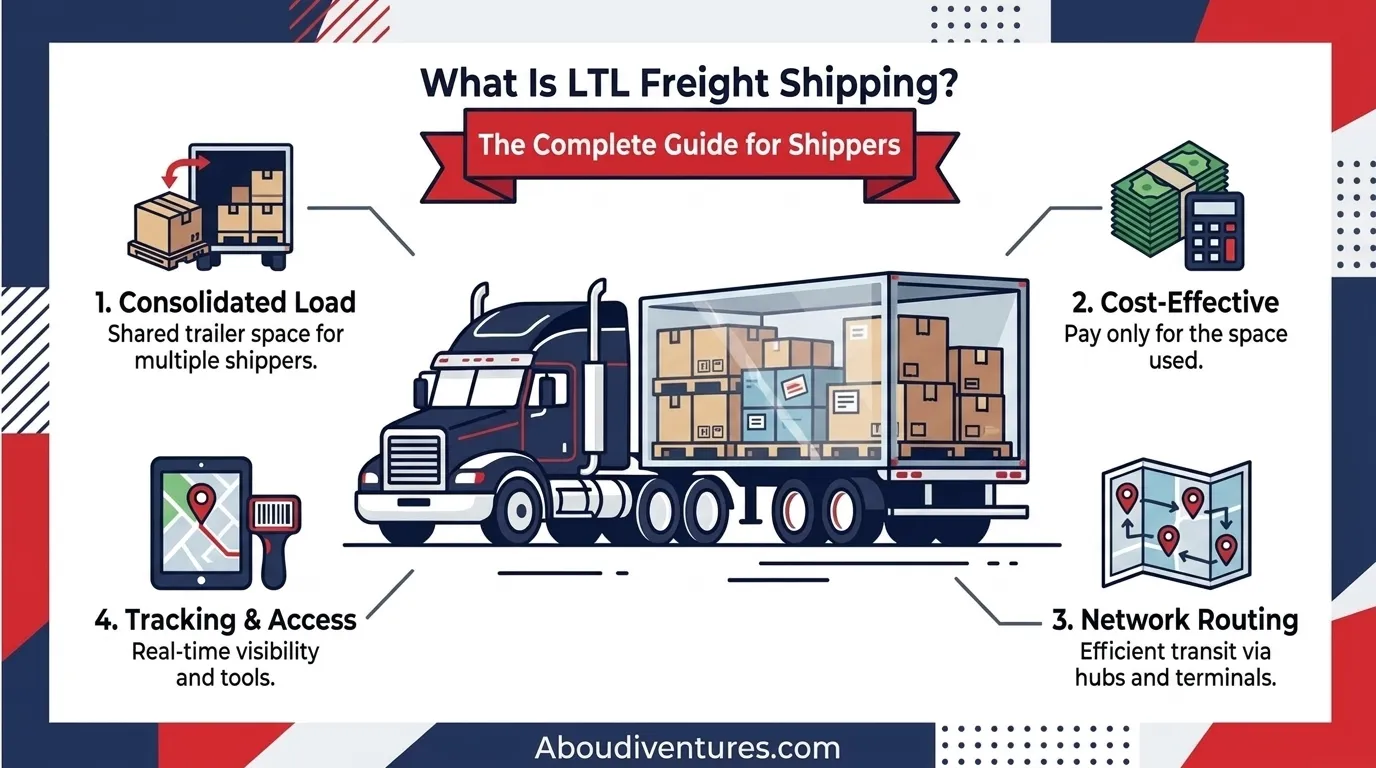
What Is LTL Freight Shipping? The Complete Guide for Shippers
If your shipment doesn’t fill a full 53-foot trailer but is too big, or too heavy, for a parcel carrier like UPS or FedEx, you’re in LTL territory. Less-than-truckload shipping is how most small and mid-size businesses move pallets across the country, and it’s also where most first-time shippers get surprised: unexpected fees, confusing freight class numbers, and rate quotes that change after pickup.
This guide breaks down what LTL actually is, how it works, what determines your price, and what to check before you book, so nothing about your next shipment catches you off guard. If you already know LTL is right for you and just want a rate, you can skip ahead to our freight shipping services page.
What Is LTL Freight Shipping?
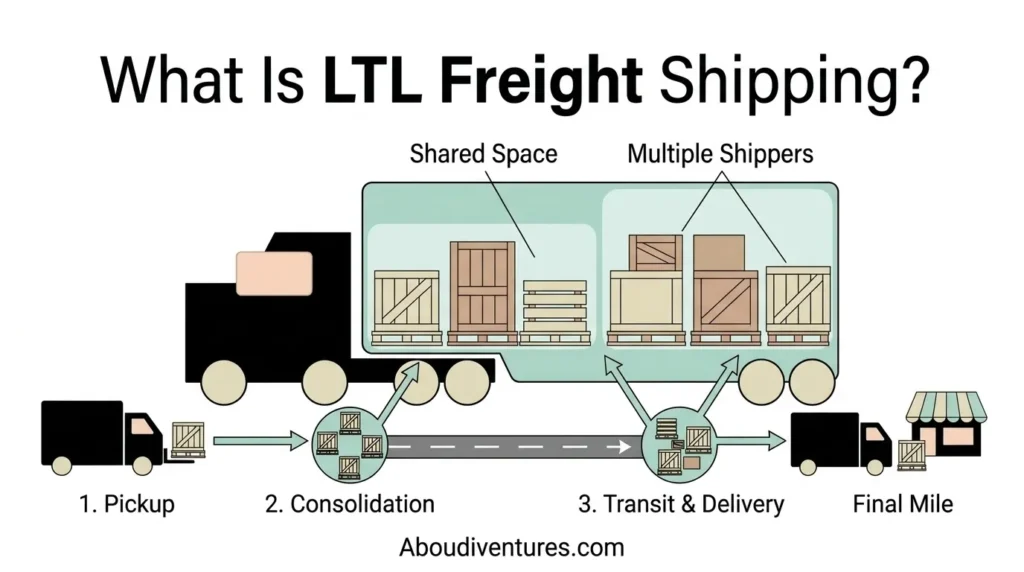
LTL stands for Less-Than-Truckload. It’s a shipping method where your freight shares trailer space with shipments from other businesses, and you only pay for the portion of the trailer you actually use.
Compare that to Full Truckload (FTL), where one shipper’s freight fills an entire trailer, start to finish, with no stops in between. LTL exists for everything that falls between a parcel box and a full trailer: generally shipments between roughly 150 and 15,000 pounds, spread across 1 to 6 pallets.
Retailers, manufacturers, distributors, and e-commerce businesses use LTL constantly. It’s the default way to move palletized freight when you don’t have, or don’t need, enough volume to justify booking a dedicated truck. Most LTL pallets travel inside a standard dry van trailer, the same enclosed equipment used for FTL dry freight, just shared across multiple shippers instead of dedicated to one.
How LTL Shipping Actually Works
Unlike FTL, which moves directly from pickup to delivery, LTL freight typically passes through a network of terminals:
- Pickup. The carrier collects your palletized shipment from your dock or facility.
- Terminal / hub sorting. Your freight arrives at a local terminal, where it’s unloaded and sorted by destination.
- Consolidation. It’s reloaded onto a trailer with freight from other shippers heading in a similar direction.
- Line-haul and possible transfer. Depending on distance, your shipment may pass through one or more regional hubs before reaching the destination terminal.
- Final delivery. The freight is transferred to a local delivery route and dropped at its destination.
This hub-and-spoke model is exactly why LTL costs less than FTL (carriers maximize every trailer’s capacity), but it’s also why LTL transit times are less predictable and handling touchpoints are higher.
LTL vs. FTL vs. Parcel: Which One Do You Need?
| Parcel | LTL | FTL | |
|---|---|---|---|
| Typical weight | Under 150 lbs | 150 to 15,000 lbs | 15,000+ lbs / fills trailer |
| Pallet count | Boxes, not palletized | 1 to 6 pallets | 10+ pallets (dedicated trailer) |
| Cost structure | Per package | Per shipment (class + weight + distance) | Flat rate for the whole trailer |
| Handling | Minimal | Multiple terminal transfers | Direct, no transfers |
| Transit speed | Fast for short distances | Moderate, terminal-dependent | Fastest, point-to-point |
| Best for | Small parcels, e-commerce orders | Palletized freight that doesn’t fill a trailer | Large volume, time-sensitive, or fragile freight |
If you’re regularly shipping 7+ pallets on a single lane, it’s worth comparing an LTL rate against a dedicated FTL quote. At that volume, FTL sometimes works out cheaper and faster, since your freight skips the terminal network entirely. And if your freight doesn’t fit inside a standard trailer at all (oversized machinery, steel, construction equipment) neither LTL nor standard FTL applies; that’s flatbed trucking territory instead.
Freight Class and NMFC: Why It Decides Your Price
This is the part that trips up almost every new LTL shipper. Every LTL shipment is assigned a freight class under the National Motor Freight Classification (NMFC) system, maintained by the National Motor Freight Traffic Association, and that class is one of the biggest factors in your rate.
Freight class is based on four factors:
- Density. Weight relative to size, the single biggest driver.
- Stowability. How easily it can be loaded around other freight.
- Handling. How much special care or equipment it requires.
- Liability. How prone the freight is to damage, theft, or damaging other freight.
Density is calculated by dividing your shipment’s weight in pounds by its volume in cubic feet. Denser freight (steel parts, machinery) gets a lower class number and a lower rate. Lighter, bulkier freight (foam, empty containers, furniture) gets a higher class number and costs more per pound to ship, because it takes up trailer space without much weight to justify it.
Why this matters: if you guess your freight class instead of calculating it accurately, carriers will re-weigh and re-class your shipment at the terminal, then adjust your invoice after pickup. That’s the single most common reason an LTL bill doesn’t match the original quote.
What Actually Determines Your LTL Rate
Once your freight class is set, carriers calculate your rate using:
- Distance between origin and destination
- Weight and dimensions of the shipment
- Freight class (as above)
- Fuel surcharge (adjusts with market fuel prices)
- Accessorial services you request or that your delivery location requires
Accessorial Fees: Where “Surprise Charges” Actually Come From
Most complaints about unexpected LTL costs trace back to accessorials: services beyond standard dock-to-dock pickup and delivery. The most common ones:
- Liftgate service. Required when either pickup or delivery location doesn’t have a loading dock, so the freight needs to be mechanically lowered to ground level.
- Limited access. Applies to locations like construction sites, storage facilities, schools, or residences that are harder for a full-size trailer to access.
- Inside pickup/delivery. When the driver needs to bring freight beyond the dock or curb.
- Residential delivery. Extra fee for delivery to a home address.
- Reweigh/reclass fee. Applied when the terminal’s measurement doesn’t match what was declared at booking.
The fix is simple but often skipped: know your pickup and delivery locations in detail, weigh and measure your freight accurately, and disclose every accessorial need before you book, not after the driver shows up.
The Bill of Lading (BOL): Your Shipment’s Contract
The BOL is the legal document between shipper and carrier that accompanies every LTL shipment. It should include:
- Accurate weight, dimensions, and freight class
- Origin and destination addresses
- A clear description of the commodity
- Any required accessorial services
- The party responsible for payment (prepaid, collect, or third-party)
A BOL with missing or inaccurate details is the fastest way to end up with a delivery delay, a reweigh fee, or a denied damage claim. Treat it as seriously as you’d treat any other shipping contract, because that’s exactly what it is.
Who Pays for an LTL Shipment?
Freight billing on the BOL falls into three categories, and getting this wrong is a common source of invoice disputes:
- Prepaid. The shipper pays the carrier directly.
- Collect. The receiver (consignee) pays the carrier upon delivery.
- Third-party billing. A broker, freight forwarder, or another company designated on the BOL pays the carrier, separate from both shipper and receiver.
Whichever party is marked as responsible on the BOL is who the carrier will invoice, so confirm this before the shipment moves, not after a bill lands with the wrong company.
When LTL Is the Right Call for Your Business
LTL makes sense when:
- You’re shipping 1 to 6 pallets and don’t have enough volume for a full trailer
- Your freight is palletized, crated, or otherwise durable enough for multiple handling points
- You don’t need an exact delivery appointment or single-touch handling
- You want to ship more frequently without waiting to build a full truckload
- You’re testing a new market and don’t want to commit to FTL volume yet
It’s not the right call when your freight is extremely fragile, time-critical to the hour, or valuable enough that multiple terminal transfers introduce more risk than the cost savings justify. That’s usually a better fit for FTL or expedited freight.
How to Prepare an LTL Shipment
- Palletize everything. Loose freight is far more likely to be damaged or delayed in a multi-carrier trailer.
- Weigh and measure before you book. Don’t estimate. This is what your freight class and final invoice are based on.
- Wrap and secure the load. Shrink wrap, banding, and corner protectors reduce shifting during transit and terminal handling.
- Label clearly. Include origin, destination, and handling instructions (This Side Up, Fragile, etc.) on every pallet.
- Disclose accessorials up front. Liftgate, limited access, and inside delivery needs should be on the BOL and the original quote, not discovered at delivery.
How to Choose an LTL Carrier
Price shouldn’t be the only factor. Before booking, it’s worth checking:
- Active operating authority. Confirm the carrier’s USDOT and MC numbers are active using FMCSA’s free SAFER lookup.
- Cargo insurance coverage. Ask what’s covered and what isn’t.
- On-time delivery track record. For your specific lanes, not just averages.
- Real-time tracking. So you know where your freight is without calling dispatch.
- Claims process. How damage or loss claims are actually handled, not just promised.
The cheapest quote on paper isn’t always the cheapest shipment once you factor in delays, damage, and accessorial surprises.
Frequently Asked Questions (FAQs)
What does LTL mean in shipping?
LTL stands for Less-Than-Truckload, a freight method where multiple shippers’ freight shares one trailer, and each pays only for the space their shipment uses.
What’s the difference between LTL and FTL?
FTL dedicates an entire trailer to one shipper’s freight, moving directly from pickup to delivery. LTL consolidates multiple shippers’ freight and routes it through terminals, which lowers cost but adds handling and transit variability.
How is LTL freight class determined?
By density, stowability, handling requirements, and liability risk, following the National Motor Freight Classification (NMFC) system. Density (weight divided by cubic footage) is usually the biggest factor.
Why did my LTL quote change after pickup?
Almost always a reweigh or reclassification: the terminal’s actual measurement of your freight didn’t match what was declared when booking. Accurate weights and dimensions at quote time prevent this.
What size shipment should go LTL instead of parcel or FTL?
Roughly 150 to 15,000 pounds, spread across 1 to 6 pallets, is the general LTL range. Below that, parcel carriers are usually cheaper; above 7,000 to 10,000 pounds or 10+ pallets, it’s worth comparing against an FTL rate.
Do I need a Bill of Lading for LTL shipments?
Yes. Every LTL shipment requires one. It’s the legal contract between you and the carrier and the primary document used to resolve disputes, delays, or claims.
Who is responsible for paying an LTL freight bill?
Whichever party is marked on the BOL: prepaid (shipper pays), collect (receiver pays), or third-party (a broker or other designated payer). Confirm this before the shipment ships, since carriers invoice based on what’s declared on the BOL.
How long does LTL shipping take?
It depends entirely on the lane. Shorter regional routes often move in 1 to 3 days, while long cross-country lanes can take a week or more, since freight may pass through multiple terminals along the way. Ask your carrier for a transit estimate specific to your origin and destination before booking.
What is a liftgate fee, and do I need it?
A liftgate lowers freight to ground level when a pickup or delivery location has no loading dock. If either location lacks a dock, you’ll need it, and should request it when booking, not after the truck arrives.
Can I track an LTL shipment in real time?
Most established LTL carriers provide tracking numbers and status updates from pickup through delivery. Ask about tracking visibility before you book if this matters for your operations.
How do I find an LTL carrier near me?
Start with carriers that already run your specific lane rather than searching generically. Ask about their coverage area, request a quote for your exact origin and destination, and confirm active operating authority before booking.
Ready to Ship LTL?
Aboudi Ventures moves LTL freight across all 49 states with upfront quotes, real-time tracking, and a dispatch team that answers the phone. If you’ve got 1 to 6 pallets ready to move, get an instant quote or call dispatch directly. No surprise fees, no guessing games.