
Hotshot Trucking: The Complete Guide (2026)
Hotshot trucking is one of the few ways left to get into the freight industry without a six-figure investment. You buy a heavy-duty pickup, hook up a trailer, and start hauling smaller, time-sensitive loads that don’t need a full semi truck.
Compare that to a Class 8 rig, the large tractor-trailer setup most people picture when they think of trucking (semi trucks, 18-wheelers, big rigs) and the entry cost, licensing, and complexity drop significantly.
This guide covers what that actually involves: the regulations, real startup costs, insurance requirements, where loads come from, how hotshot compares to other trucking models, and why some operators don’t make it past year one.
What Is Hotshot Trucking?
Hotshot trucking (sometimes written as hot shot trucking, and known in the industry as hotshot hauling or hotshot freight) means moving smaller, time-sensitive freight using a medium-duty truck, typically a one-ton pickup like a Ford F-350/F-450, Ram 3500, or Chevy Silverado 3500HD, paired with a flatbed, gooseneck, or step-deck trailer.
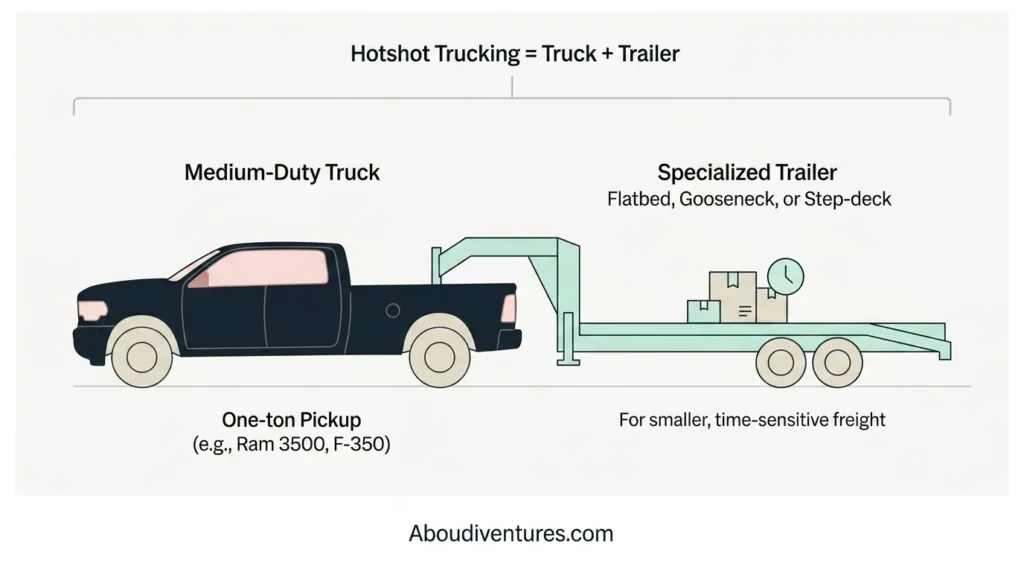
Loads are usually less-than-truckload (LTL) shipments: construction materials, machinery parts, oilfield equipment, or vehicles, moving point-to-point on a tight deadline.
Hotshot trucking vs. expedited shipping, they’re not the same thing. Expedited carriers keep trucks on standby, ready to move the moment a rush load comes in. Hotshot operators instead work off load boards and broker relationships, actively sourcing jobs as they come.
That distinction matters because it changes how you plan your week: expedited work leans toward on-call availability, hotshot work leans toward actively hunting for freight. Established carriers that run both models side by side, like Aboudi Ventures’ flatbed and expedited freight services, are a useful reference point for seeing how the two actually differ in day-to-day operation.
How Hotshot Trucking Compares to Other Trucking Models
| Model | Equipment | CDL Needed? | Startup Cost | Typical Freight |
|---|---|---|---|---|
| Hotshot trucking | Medium-duty pickup + gooseneck/flatbed trailer | Often not (under 26,001 lbs GVWR) | $15,000–$100,000 | Smaller, time-sensitive LTL loads |
| Traditional OTR trucking | Class 8 semi-truck + 53-ft trailer | Yes, Class A required | $150,000+ | Full truckload, long-haul freight |
| Expedited freight | Sprinter van, box truck, or semi, kept on standby | Depends on vehicle class | Varies widely | Time-critical, on-call loads |
This comparison matters because a lot of people searching “hotshot trucking” are really deciding between three different business models, not just researching one. If your priority is lower entry cost and flexible scheduling, hotshot wins. If it’s higher, steadier per-load revenue on longer hauls, traditional OTR trucking is the better fit. If you want guaranteed on-call work rather than actively sourcing freight, expedited hauling is closer to what you’re picturing.
Do You Need a CDL for Hotshot Trucking?
This is the single most-asked question about hotshot trucking, and the honest answer is: it depends on weight, and it depends on your state.
Federal rule: If your truck and loaded trailer have a combined Gross Vehicle Weight Rating (GVWR) of 26,001 lbs or less, you do not need a Commercial Driver’s License. Cross that threshold and you need a Class A CDL. The FMCSA’s official CDL guidance is the authoritative source if you want to confirm this directly rather than relying on a summary.
The part most guides skip, state variance: The federal 26,001 lb line is a floor, not a universal rule. Some states require a CDL (or at least a non-CDL commercial license) for commercial vehicles over 10,000 lbs, especially once you cross state lines or operate “for hire.” Before you assume you’re CDL-exempt, check your specific state’s DOT rules. This is the most common source of confusion for new operators, because a truck that’s federally exempt can still trip a stricter state threshold.
The GVWR trap: Here’s something almost nobody explains clearly. Two trailers that look identical can carry different GVWR ratings. A 40-foot gooseneck, for example, might come in a 12,000 lb-rated version and a 14,000 lb-rated version from the same manufacturer. Pair the lighter-rated trailer with your truck and you might stay under 26,001 lbs combined; pair the heavier one and you’re suddenly CDL-required. Always check the GVWR plate before you buy a trailer, don’t assume based on size or looks.
Should you get a CDL anyway, even if you don’t need one? Many experienced operators do, for a few reasons:
- It opens up heavier, better-paying freight without a weight ceiling.
- Insurance underwriters often price CDL holders lower, even on non-CDL setups, because it signals more training.
- It gives you room to scale into a second truck or heavier equipment later without re-qualifying.
Regulatory Checklist: What You Actually Need to File
Whether or not you need a CDL, once you’re hauling commercially and crossing state lines, you’re subject to FMCSA rules. Here’s the full list most articles only half-cover:
- USDOT Number. Your basic federal registration, required before you move a single load.
- MC Authority (Operating Authority). Required for for-hire interstate carriers.
- BOC-3 Filing. A legal requirement designating a “process agent” in every state you operate in, who can accept legal documents on your behalf. Third-party filing services handle this for a small annual fee, typically well under $100. You don’t do this yourself.
- UCR (Unified Carrier Registration). An annual registration and fee based on fleet size, required for interstate carriers. Missing your UCR renewal can get your authority flagged. Register directly through the official UCR site rather than a third-party lookalike page.
- IRP (International Registration Plan) and IFTA (International Fuel Tax Agreement). If you run heavier rigs across multiple states, you may owe apportioned registration fees (IRP) and fuel tax reporting (IFTA). Purely regional, lighter-weight operators sometimes qualify for exemptions, check your state’s threshold.
- New Entrant Safety Audit. The FMCSA audits every new authority within its first 12 months. Common reasons operators fail: missing driver qualification files, incomplete drug/alcohol testing program enrollment, and missing HOS/ELD records. Get your paperwork organized before you start hauling, not after the audit notice arrives.
- ELD (Electronic Logging Device) requirements. Most hotshot drivers need one, since even an empty medium-duty truck often crosses the 10,001 lb threshold that triggers Records of Duty Status. There’s a short-haul exemption if you operate within a 150 air-mile radius of your home base and meet a few other conditions (return to base within 14 hours, no CDL required for your vehicle). Even then, you still have to log time in, time out, and total hours daily.
Equipment: Trucks, Trailers, and What Actually Matters
Trucks. Most hotshot operators run a dual-rear-wheel (DRW) Ford F-350/F-450, Ram 3500, or Chevy Silverado 3500HD diesel. DRW vs. SRW (single-rear-wheel) is a real decision, not just preference. A DRW truck typically carries 1,500–2,500 lbs more payload than its SRW twin, and gives you a wider, more stable footprint under a loaded gooseneck. SRW only makes sense for a light, non-CDL setup where you’re staying well under load ratings and want easier daily driving.
Trailers. The industry standard is a 40-foot gooseneck flatbed. Step-deck and dovetail trailers cover specialized freight like tall equipment or drive-on loads. Whatever you choose, build a proper securement kit (straps, chains, binders, tarps) and confirm your GVWR/GCWR limits before you ever accept a load (see the GVWR trap above).
What It Really Costs to Start a Hotshot Trucking Business
Every guide throws out a number. Here’s what actually goes into it:
| Item | Typical Range |
|---|---|
| Truck (if you don’t already own one) | $30,000–$70,000+ |
| Trailer | $10,000–$20,000 |
| Insurance down payment | $3,000–$5,000 |
| LLC/business registration and filing fees | $1,000 |
| BOC-3, UCR, MC Authority filing fees | A few hundred dollars |
| Securement equipment (straps, chains, tarps) | $500–$1,500 |
| Load board subscriptions | $35–$50/month, per platform |
All-in, most sources land in the $15,000–$45,000 range if you already own a truck, or $30,000–$100,000+ if you’re buying both truck and trailer from scratch (a range echoed by DAT’s hot shot trucking startup guide as well).
If fronting that capital and running your own authority feels like too much too soon, leasing on with an established carrier is worth considering as a lower-risk entry point. Carriers like Aboudi Ventures that welcome owner-operators let you haul under their MC authority and insurance while you build experience and capital before going independent.
The Real Monthly P&L (Not Just a Gross Income Number)
Most articles quote gross income, $40,000 to $120,000 a year, and stop there. That number means almost nothing without expenses attached. Here’s a rough single-truck monthly breakdown to actually plan around:
- Revenue. Varies heavily by lane and load type, but operators targeting $2.50–$3.50+/mile all-in tend to stay profitable.
- Fuel. Often the single largest operating cost.
- Insurance. $665–$2,085/month for a single non-CDL truck, depending on driving record, cargo type, and coverage limits.
- Truck/trailer payment. If financed.
- Maintenance reserve. Set aside monthly; medium-duty trucks running hard miles need this more than people expect.
- Factoring fees. If you use a factoring company to get paid faster instead of waiting on broker net-30 terms, expect a percentage fee off each invoice (recourse factoring is cheaper but riskier, non-recourse costs more but protects you if a broker doesn’t pay).
- Deadhead miles. The miles you drive empty, to or from a load, eat directly into your effective rate per mile. A $4/mile load can become a $2/mile load once 100 miles of deadhead on each end are factored in. Always calculate your rate after deadhead, not before.
Most sources land on $6,000–$10,000/month in net profit for a well-run single truck once expenses are subtracted, but that number swings hard based on lane selection, deadhead control, and how disciplined you are about expenses.
Insurance: Every Coverage Type You Actually Need, in One Place
Hotshot insurance is fragmented across dozens of insurance-company blogs, each covering one policy type. Here’s all of it consolidated:
| Coverage | What It Covers | Typical Requirement |
|---|---|---|
| Primary auto liability (BIPD) | Bodily injury/property damage you cause | FMCSA minimum $750,000; most brokers require $1,000,000 |
| Cargo insurance | Damage or loss to freight you’re hauling | Often $5,000–$100,000+ depending on cargo value |
| Physical damage | Your own truck/trailer, collision and comprehensive | 3%–12% of equipment value annually |
| Bobtail insurance | Liability while driving the truck without a trailer, between loads | Not federally required, but practically essential |
| Non-trucking liability (NTL) | Liability when the truck is used off-duty, not under dispatch | Fills the gap bobtail and primary liability don’t cover |
| Trailer interchange | Trailers you pull but don’t own, under written agreement | Situational, needed if you swap trailers |
| General liability | Business exposures off the truck (loading dock incidents, etc.) | Often required by shipper contracts |
Bobtail vs. non-trucking liability, the distinction nobody explains clearly: Bobtail covers you driving the truck without a trailer attached, between loads. Non-trucking liability covers you driving the truck (with or without trailer) for personal, non-business purposes. They sound similar but cover different situations, many operators carry both.
What actually lowers your premium: a clean CDL (even when not required), a clean motor vehicle record, running a gooseneck or fifth-wheel setup (wider carrier appetite), matching your cargo limit to your actual freight instead of over-insuring, and taking a higher physical damage deductible. Rates also tend to drop after your first claims-free year of authority. For a deeper breakdown of non-CDL coverage costs specifically, FreightWaves’ non-CDL hotshot insurance guide is a solid independent reference.
How to Find Hotshot Loads
New operators typically mix these sources rather than relying on one:
- Freight brokers. Do the legwork of finding and negotiating loads, but take a cut.
- Load boards. DAT, Sylectus, 123Loadboard, and TruckSmarter are the major platforms.
- Direct shipper relationships. Construction firms, oilfield service companies, and equipment/auto dealers often need regular expedited hauls. Building these relationships bypasses broker margins entirely, but takes time and consistent, clean service to earn.
- Government freight. An underused channel. Register for free on SAM.gov to bid on federal, state, and military transportation contracts. Search terms like “LTL,” “flatbed,” and “expedited delivery.” Fewer operators know about this channel, so competition is lower and pay can run 20–40% above market rate.
- Broker partnerships with an established carrier. If you’d rather have consistent freight lined up than cold-source every load yourself, some carriers run broker partnership and owner-operator programs that hand you steadier lane assignments instead of leaving you to compete solo on load boards.
Load Board Comparison
| Platform | Approx. Monthly Cost | Known For |
|---|---|---|
| DAT | $35–$50 | Largest load volume, widely used by brokers |
| Sylectus | $35–$50 | Strong for expedited and team-based dispatch networks |
| 123Loadboard | $35–$50 | Budget-friendly, simpler interface for newer operators |
| TruckSmarter | Free tier available | App-based, popular with owner-operators for ease of use |
Niche freight and its rate premiums:
- Oversized/permitted loads: $3.00–$4.00+/mile. Most drivers avoid the extra paperwork, so competition is thin.
- Oilfield freight (pipe, valves, wellhead equipment): $2.50–$3.50/mile. Requires knowing the oilfield schedule and short-notice availability.
- Auto hauling: consistent demand, repeat dealer-to-dealer customers.
The 2026 shift worth knowing: rates have compressed compared to a few years ago, and full truckload-price bookings are less common. Experienced operators increasingly take partial loads and combine them strategically to protect their per-mile rate, treating load-stacking as a core skill rather than a fallback.
Is Hotshot Trucking Right for You? A Quick Decision Checklist
Use this before you commit to buying equipment:
- Can you cover 2–3 months of expenses (fuel, insurance, truck payment) without relying on your first month’s freight income?
- Are you comfortable with income that varies week to week, rather than a fixed schedule?
- Do you have (or are you willing to build) a maintenance reserve fund for a hard-working medium-duty truck?
- Have you checked your specific state’s CDL weight threshold, not just the federal 26,001 lb rule?
- Are you prepared to actively source freight (load boards, brokers, direct shippers) rather than waiting for work to come to you?
- Do you have a plan for cash flow between delivering a load and getting paid by the broker (30+ days out)?
If you answered “no” to two or more of these, it’s worth reading the section below before you buy anything.
When Hotshot Trucking Might Not Be the Right Fit
This model tends to work well for people who want flexibility, lower startup costs than a full Class 8 rig, and direct control over their business, and who are disciplined about tracking expenses, deadhead miles, and cash flow. It’s a tougher fit for people who want predictable, steady income, who can’t absorb a slow month without missing a truck payment, or who feel uneasy with week-to-week revenue swings, since freight volume shifts with the market.
Most hotshot content skips why some operators don’t make it past year one, largely because much of it is written by insurance companies, truck dealers, or factoring services trying to sell you something. The honest reasons operators struggle:
- Cash flow gaps. Brokers often pay on net-30 terms, but fuel, truck payments, and insurance are due now. This is the single biggest reason new operators either turn to factoring or run out of working capital.
- Underestimating total cost of ownership. Maintenance on a medium-duty truck running hard, loaded miles adds up faster than expected, especially without a reserve fund.
- Chasing rate instead of margin. A high rate-per-mile load with heavy deadhead on both ends can net less than a “boring” local load with none.
- Rate competition. More operators have entered the space as barriers to entry stay low, compressing rates in the most common lanes.
Is Hotshot Trucking Worth It in 2026?
It depends on the operator. If you go in with a real budget (not just a truck-and-trailer number), understand your state’s CDL threshold, insure yourself properly across all the coverage types above, and diversify how you source loads, hotshot trucking remains one of the more accessible entry points into the freight and logistics industry.
Frequently Asked Questions (FAQs)
Do I need a CDL for hotshot trucking?
Not if your truck and loaded trailer stay at or under 26,001 lbs combined GVWR, that’s the federal threshold. Some states set a stricter line, so check your state’s specific rule before assuming you’re exempt.
What’s the difference between hotshot trucking and expedited shipping?
Expedited carriers keep trucks on standby for rush loads. Hotshot operators source freight actively through load boards and brokers rather than waiting on standby.
How much does it really cost to start?
Roughly $15,000–$45,000 if you already own a capable truck, or $30,000–$100,000+ if you’re buying both truck and trailer, once insurance, filings, and equipment are included.
How much can I realistically make after expenses?
Many well-run single-truck operations net roughly $6,000–$10,000/month, but this depends heavily on lane selection, deadhead control, and expense discipline. Gross income figures alone are misleading.
What’s the difference between bobtail and non-trucking liability insurance?
Bobtail covers the truck without a trailer attached, between loads. Non-trucking liability covers the truck used for personal, non-business purposes. Many operators carry both.
What is a BOC-3 filing and do I need one?
It’s a required designation of a process agent in every state you operate in, who can accept legal paperwork on your behalf. A third-party filing service typically handles this for a small annual fee.
How do I avoid failing my FMCSA new-entrant safety audit?
Have your driver qualification file, drug/alcohol testing program enrollment, and HOS/ELD records organized before your first load, not after the audit notice arrives.
Can I hotshot part-time?
Yes, many operators start this way while keeping other income, though full regulatory requirements (authority, insurance, filings) still apply regardless of how many hours you run.
How do I find loads without giving up a big cut to brokers?
Mix load boards, direct shipper relationships (construction, oilfield, auto dealers), and government freight via SAM.gov. Direct relationships and government contracts typically pay better than broker-sourced loads.
How does factoring work, and is it worth the fee?
Factoring companies pay you immediately for an invoice (minus a fee) instead of you waiting on a broker’s net-30 terms. Non-recourse factoring costs more but protects you if the broker doesn’t pay; recourse factoring is cheaper but puts that risk back on you.
What trailer GVWR keeps me under the CDL threshold?
Check the GVWR plate on the specific trailer. Identical-looking trailers from the same manufacturer often come in different GVWR ratings, and the wrong one can push your combined weight over 26,001 lbs.
Do I need IFTA or IRP if I only run regionally?
Purely regional, lighter-weight operators sometimes qualify for exemptions, but multi-state or heavier operations typically owe apportioned registration (IRP) and fuel tax reporting (IFTA). Check your state’s specific threshold.
Is hotshot trucking worth it in 2026?
It depends on the operator’s tolerance for variable income and discipline around cash flow. Rate compression and more competition have made it tougher than a few years ago, but it’s still one of the lowest-barrier ways into the freight industry when run with a real budget and diversified load sourcing.
Next Steps
If you’re still early in deciding, start with the checklist above and confirm your state’s CDL threshold before spending anything. If you’re ready to move forward, get your insurance quotes and BOC-3/UCR filings lined up before you buy a truck or trailer, since financing and insurance underwriting both depend on having your authority structure in place.
If running your own authority feels premature, reach out to Aboudi Ventures about owner-operator and lease-on options, or browse their full truckload and flatbed services to see how an established carrier structures freight, insurance, and dispatch before you build all three yourself.