
Flatbed Trucking Guide 2026: What Shippers Need to Know Before Booking a Flatbed Truck
If your freight doesn’t fit inside a standard trailer steel beams, construction equipment, oversized machinery, or anything too tall, wide, or awkward for a dry van you’re looking at flatbed trucking.
This guide is written specifically for shippers and businesses trying to figure out how flatbed freight actually works before they book a load: what it costs, what’s expected of you as the shipper, how to avoid common mistakes, and how to pick a carrier you can trust with expensive equipment. We’ll focus purely on what you need to know to ship with confidence.
What Is Flatbed Trucking?
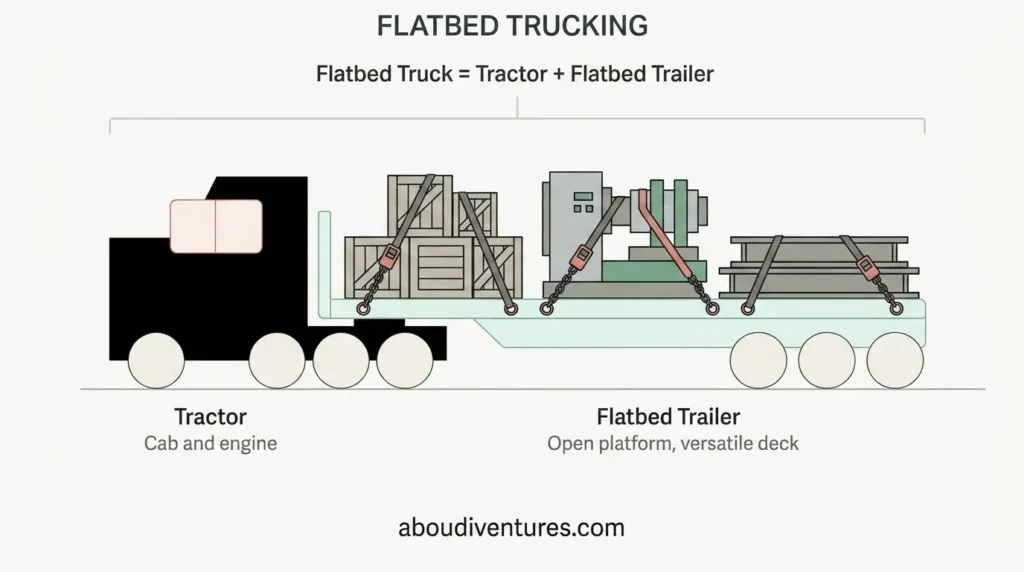
Flatbed trucking is a freight transport method that uses trailers with an open, flat deck, no roof, no side walls. Instead of loading cargo through rear doors like a dry van, freight is loaded from the top, side, or rear using a crane, forklift, or ramp, then secured to the deck with straps, chains, or tarps. It’s the standard solution for cargo that’s too large, too heavy, or too irregularly shaped for an enclosed trailer.
What Is a Flatbed Truck? Main Types
Not every flatbed is the same, and the type your freight needs affects both cost and legality. The most common configurations are:
- Standard Flatbed – A flat deck about 48–53 feet long, 8’6″ wide. The default choice for construction materials, machinery, and palletized freight that’s simply too big for a van.
- Step Deck (Drop Deck) – A lower rear deck that legally allows cargo up to about 10 feet tall without needing an oversize permit.
- Double Drop Deck – An even lower center section, used for very tall freight like industrial equipment, up to roughly 12 feet.
- Removable Gooseneck (RGN) – The front detaches so equipment can be driven or rolled directly onto the deck — the go-to for heavy machinery like excavators and bulldozers.
- Extendable Flatbed – A deck that stretches to carry unusually long freight (pipes, beams, wind turbine blades) without overhang violations.
Flatbed vs. Dry Van: Which One Does Your Shipment Need?
| Factor | Flatbed | Dry Van |
|---|---|---|
| Cargo shape | Oversized, irregular, or heavy machinery | Boxed, palletized, standard freight |
| Loading | From top/side/rear via crane or forklift | Rear doors only |
| Weather exposure | Exposed unless tarped | Fully enclosed |
| Typical rate (2026 national avg.) | ~$3.00–$3.70/mile | ~$2.30–$2.70/mile |
| Best for | Steel, lumber, construction equipment, vehicles | Retail goods, packaged goods, general freight |
If your freight fits in a box and needs weather protection, dry van almost always wins on cost. If it’s oversized, needs top-loading, or simply won’t fit inside a trailer, flatbed is the only real option.
What Can You Ship on a Flatbed Truck?
Flatbed trailers regularly move:
- Construction materials — steel beams, pipe, rebar, drywall, concrete panels
- Heavy machinery — excavators, tractors, generators, industrial equipment
- Vehicles and recreational equipment
- Lumber and building supplies
- Metal coils, sheets, and bar stock
- Bagged bulk materials (sand, gravel, aggregate)
Flatbed Truck Weight Limits and Dimensions
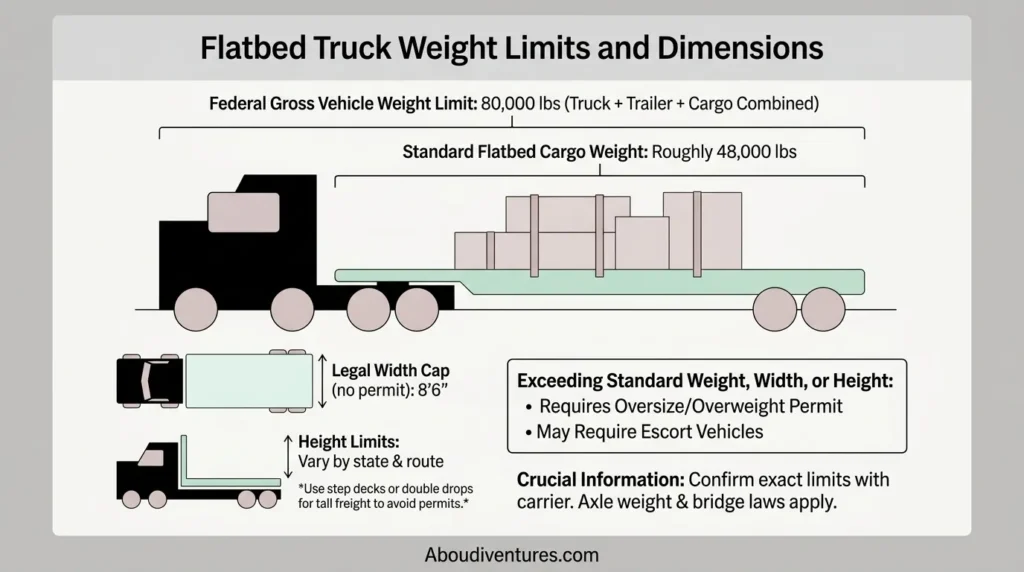
A standard flatbed can legally carry roughly 48,000 pounds, within the federal 80,000-pound gross vehicle weight limit (truck + trailer + cargo combined).
The legal width cap without a permit is 8’6″, and height limits vary by state and route, this is why step decks and double drops exist, to keep tall freight under legal height without triggering a permit.
Anything that exceeds standard weight, width, or height needs an oversize/overweight permit and, in some cases, escort vehicles. Always confirm exact limits with your carrier before finalizing dimensions bridge laws and axle weight limits can restrict what the 80,000-pound federal cap technically allows.
How Much Does Flatbed Trucking Cost in 2026?
As of mid-2026, national flatbed spot rates are averaging roughly $3.00–$3.70 per mile, running about $0.20–$0.40 higher than dry van due to the extra labor, equipment, and skill flatbed hauling requires. As a shipper, your actual quote depends on:
- Distance and lane — shorter hauls (under 200 miles) often carry a 15–25% premium because fixed costs get spread over fewer miles
- Tarping requirements — expect an added $75–$150 depending on tarp size and load type
- Permits — oversize/overweight loads add permit fees plus possible escort vehicle costs
- Season — flatbed capacity tightens in spring/summer construction season, pushing rates up
- Lead time — booking 3–5 days ahead is meaningfully cheaper than same-day or next-day requests
The most reliable way to get an accurate number is a direct quote from a licensed carrier rather than a generic rate calculator, since lane-specific capacity swings the price more than any average.
How to Prepare Your Freight for Flatbed Shipping (Checklist)
Because flatbed loading is open-deck, more responsibility falls on the shipper to prep freight correctly than with a sealed van. Before pickup:
- Measure and weigh your freight accurately — incorrect dimensions cause permit issues and rejected pickups.
- Confirm if tarping is needed — moisture-sensitive freight (lumber, drywall, machinery with electronics) should always be tarped.
- Ask who handles securement — carriers are responsible for load securement compliance, but shippers should confirm strap points, pallet stability, and packaging beforehand.
- Photograph the freight before loading — protects you in case of damage disputes.
- Flag anything oversize early — permits can take days to process; don’t wait until pickup day to mention a load is 9 feet tall.
- Confirm accessorials upfront — detention, layover, and TONU (truck-order-not-used) fees should be discussed before booking, not after.
Questions to Ask Before Booking a Flatbed Carrier
Not every “carrier” quoting you is actually a carrier many are unlicensed brokers reselling capacity. Before you book, ask:
- What’s your MC and USDOT number? (You can verify these free at safer.fmcsa.dot.gov)
- Is my freight covered by cargo insurance, and what’s the coverage limit?
- Do you dispatch your own trucks, or is this load being re-brokered?
- What’s included in the quote — is tarping, permitting, or detention extra?
- Can I get real-time tracking on this load?
A legitimate, insured carrier will answer all of these without hesitation.
How Aboudi Ventures Handles Flatbed Freight
Aboudi Ventures LLC operates flatbed and heavy-haul equipment, including standard flatbeds, step decks, and RGN trailers, as a licensed, DOT-compliant carrier (MC #1757911, USDOT #4458409) running lanes across the lower 49 states.
Every load is insured, tracked in real time, and handled by a dispatch team available around the clock, so oversize permitting and tie-down planning are managed for you instead of left as a surprise on pickup day.
You can see the full breakdown of equipment and capabilities on our Flatbed & Heavy Haul services page, or compare it against our Full Truckload (FTL) service if you’re not yet sure which trailer type fits your freight.
Frequently Asked Questions (FAQs)
1. How much weight can a flatbed truck carry?
A standard flatbed trailer carries approximately 48,000 pounds of cargo while staying within the federal 80,000-pound gross vehicle weight limit for the truck, trailer, and freight combined. Actual capacity depends on axle configuration and state weight laws.
2. What is the difference between a flatbed and a step deck?
A standard flatbed has one flat deck level, while a step deck (drop deck) has a lower rear section, allowing cargo up to about 10 feet tall to be legally hauled without triggering oversize-height permit requirements.
3. Do I need a permit to ship oversized freight on a flatbed?
Yes, if your cargo exceeds the standard legal limits of 8’6″ in width or certain height thresholds (which vary by state), you’ll need an oversize/overweight permit, and very large loads may require escort vehicles.
4. Is flatbed shipping more expensive than dry van?
Generally yes, flatbed rates run about $0.20–$0.40 per mile higher than dry van in 2026 due to the additional equipment, tarping, and securement skill required, though the exact gap depends on your lane and season.
5. Who is responsible for securing freight on a flatbed truck?
The carrier is legally responsible for load securement compliance under FMCSA regulations, but shippers should confirm packaging, pallet stability, and strap points with the carrier before pickup to avoid delays.
Final Thoughts
Flatbed trucking isn’t complicated once you know what to check before you book: the right trailer type for your freight’s size, an accurate weight and dimension count, whether tarping or permits apply, and most importantly a carrier that’s actually licensed and insured rather than a reseller adding a markup and a middleman. Get those four things right, and flatbed shipping is just as predictable as any other freight mode.
Ready to move oversized or heavy freight? Get an instant flatbed quote from Aboudi Ventures licensed, insured, and dispatched 24/7 across all 49 states. Call (945) 382-8253 or request your quote online in under two minutes.