
What Is a Dry Van? The Complete Guide to Dry Van Trucks, Trailers & Shipping
If you’ve spent any time on a highway, you’ve seen one: a long, rectangular, fully enclosed trailer rolling behind a semi-truck. That’s a dry van, and it’s the single most common piece of equipment in the entire freight industry. Dry vans move somewhere between 70-80% of all truckload freight in the United States, which means there’s a very good chance that whatever you’re wearing, eating, or sitting on right now spent part of its journey inside one.
Yet plenty of people still get tripped up by the basics: what exactly counts as a dry van, how much it can hold, what it should (and shouldn’t) haul, and how it compares to the other trailers on the road. This guide breaks all of it down in straightforward, everyday language, so you walk away with real answers instead of more confusion.
What Is a Dry Van?
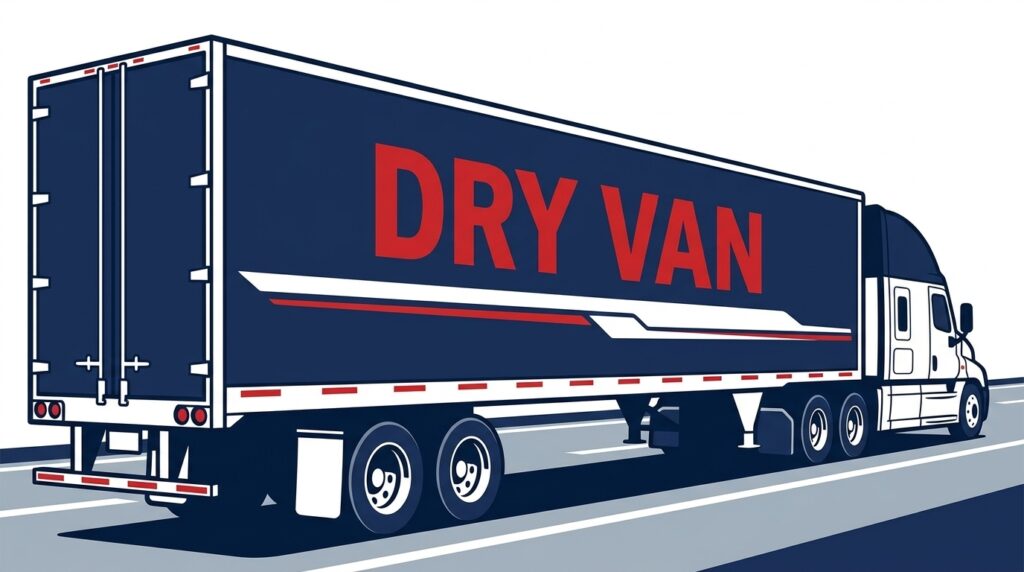
The dry van comes with full solid walls, a roof, and rear doors. A dry van is a fully enclosed trailer with solid walls, a roof, and rear doors. Think of it as a giant, weatherproof box on wheels. Unlike a flatbed, which leaves cargo exposed, or a reefer, which controls temperature, a dry van simply protects whatever’s inside from rain, wind, dust, and road debris. That’s it. No refrigeration, no open sides, just a sealed container built for one job: getting goods from point A to point B in the same condition they left in.
You’ll also hear a dry van called a “box trailer” or a “dry van truck,” all three terms point to the same piece of equipment. It’s the workhorse of American freight because it’s simple, durable, and works with practically every loading dock in the country.
What Is a Dry Van Truck vs. a Dry Van Trailer?
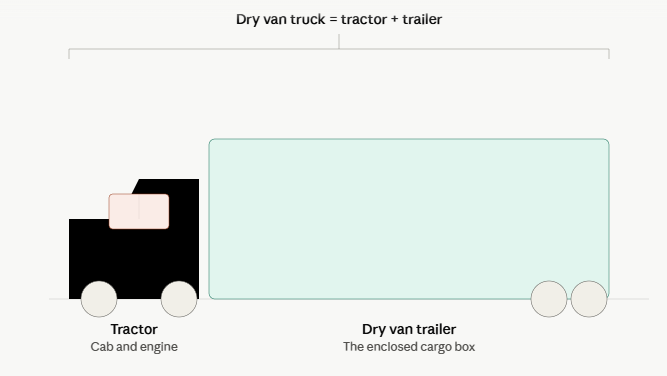
This trips people up constantly, so let’s clear it up. A dry van trailer is the enclosed box itself, the part that holds the freight. A dry van truck usually refers to the whole rig: the tractor (the cab and engine) pulling that trailer. In everyday conversation, people use the terms interchangeably, and that’s fine, but technically, the trailer is the cargo box, and the truck is what pulls it.
Dry Van Trailer Dimensions and Specifications
Numbers matter in freight, since they determine how much you can load and whether a shipment fits. Here’s what a standard dry van looks like on paper.
| Spec | 53′ Dry Van | 48′ Dry Van |
| Exterior length | 53 ft | 48 ft |
| Exterior width | 8’6″ (102″) | 8’6″ (102″) |
| Exterior height | 13’6″ | 13’6″ |
| Interior height | 110-111″ | 110″ |
| Interior width | 100″ | 100″ |
| Usable cargo volume | 3,800-4,100 cu ft | 3,000-3,500 cu ft |
| Standard pallet capacity | 26-30 pallets | 24 pallets |
| Max cargo weight | 42,000-45,000 lbs | 42,000-45,000 lbs |
A few practical notes worth knowing:
- Weight isn’t usually the limit, space is. Most loads “cube out” (run out of room) before they “weigh out” (hit the legal weight cap). That’s why pallet configuration matters so much.
- The 80,000-lb rule governs everything. Federal law caps the total gross weight of tractor, trailer, and cargo at 80,000 lbs. Since the tractor and empty trailer already account for roughly 30,000-38,000 lbs combined, that leaves the remaining weight for the actual freight.
- Pallet orientation changes capacity. Loading standard 48″x40″ pallets “turned sideways” across the trailer width typically nets more pallet positions than loading them lengthwise, a small detail that adds up to real revenue over hundreds of loads a year.
How Dry Van Shipping Actually Works
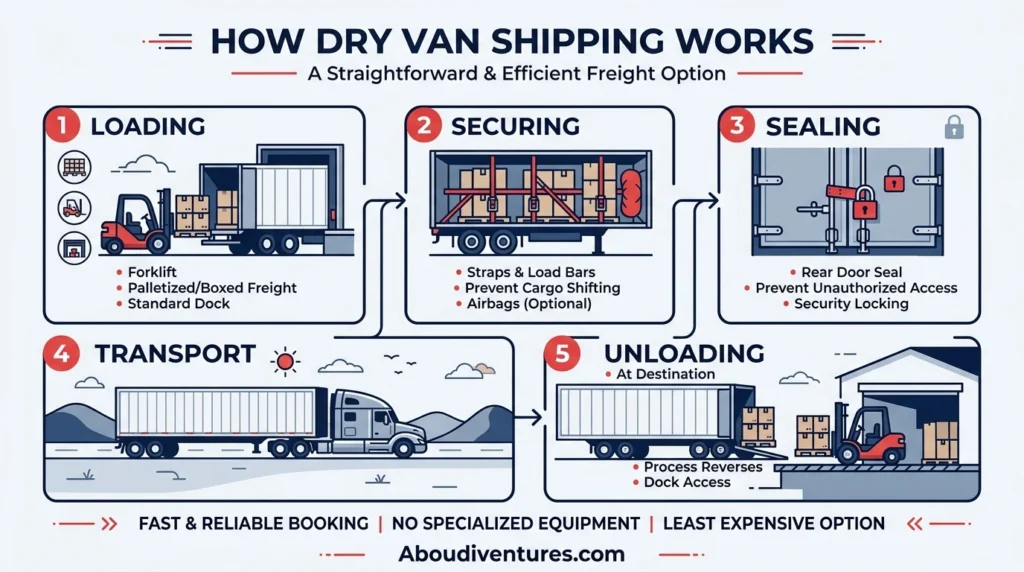
The process is refreshingly straightforward compared to specialized freight:
- Loading: Freight is palletized, boxed, or loaded loose, then packed into the trailer using a forklift or pallet jack at a standard loading dock.
- Securing: Straps, load bars, or airbags keep freight from shifting during transit.
- Sealing: For security purpose rear doors are often sealed to prevent unauthorized access
- Transport: The trailer is hauled over the road, with no climate control or special handling needed en route.
- Unloading: At the destination, the process reverses at another standard dock.
Because dry vans don’t require any specialized loading equipment or temperature monitoring, they’re generally the fastest and least expensive freight option to book, which is one reason they dominate the market.
What Can Be Shipped in a Dry Van?
Dry van freight covers almost anything that doesn’t need temperature control:
- Merchandise in general (clothing, electronics, household items)
- A variety of packaged and non-perishable foods and beverages
- The furniture and home goods industry
- Manufactured parts, machinery components, and building materials
- Retail and e-commerce inventory
- Paper goods, packaging materials, and consumer packaged goods (CPG)
What doesn’t belong in a dry van: perishables that need refrigeration (produce, dairy, meat), oversized or heavy machinery that requires a flatbed, and anything requiring specialized handling like hazardous materials with temperature sensitivity.
Dry Van vs. Reefer vs. Flatbed: What’s the Difference?
| Feature | Dry Van | Reefer | Flatbed |
| Enclosure | Fully enclosed | Fully enclosed, insulated | Open, no walls |
| Temperature control | None | Yes | None |
| Best for | Packaged, non-perishable goods | Perishables, pharma | Oversized, heavy, or irregular loads |
| Loading method | Dock-to-dock, forklift | Dock-to-dock, forklift | Crane, forklift, side-load |
| Typical weight (empty) | 13,500-15,000 lbs | Heavier (insulation + refrigeration unit) | Often lighter |
| Cost to operate | Lowest | Highest (fuel for reefer unit) | Moderate |
The short version: if your freight is packaged and doesn’t need to stay cold or oversized, a dry van is almost always the simplest and cheapest way to move it.
Why Dry Van Transportation Is So Widely Used
- Cost efficiency: No refrigeration unit to run, no specialized equipment to rent. Dry vans are consistently the most affordable trailer type on a per-mile basis.
- Availability: Because they make up the majority of the national trailer fleet, dry vans are easier to source, even during high-demand seasons when specialized equipment gets scarce.
- Universal compatibility: Nearly every warehouse and distribution center in the country is built around standard dock heights designed for dry van trailers.
- Cargo protection: The fully enclosed design shields freight from weather, road debris, and theft far better than an open trailer.
Dry Van Freight Rates: What Affects the Price?
Dry van rates fluctuate based on a handful of factors:
- Distance and lane: Longer hauls and less-traveled lanes typically cost more per mile.
- Regional demand: Rates tend to run higher in the West and Midwest, and lower in the Northeast, though this shifts with seasonal freight patterns.
- Fuel prices: Since fuel is one of the largest variable costs in trucking, rate quotes move with fuel markets.
- Accessorials: Extra requirements like liftgate service, strict delivery windows, or detention time at the dock can add to the base rate.
If you’re a shipper, getting a rate quote usually means providing pickup/delivery locations, weight, and any special handling needs. If you’re a carrier or owner-operator, working with an experienced dispatcher can help you find loads that pay well for the lane you’re already running.
Finding Dry Van Loads (For Carriers and Owner-Operators)
Owner-operators and small fleets typically source dry van freight in one of three ways:
- Load boards: Digital marketplaces where brokers post available freight and carriers bid or book directly.
- Direct broker relationships: Repeat business with brokers who consistently have freight in your preferred lanes.
- Dispatch services: A dedicated dispatcher handles load searching, rate negotiation, paperwork, and scheduling, freeing up drivers to focus on the road instead of the phone.
For many owner-operators, the difference between a mediocre dispatcher and a great one comes down to relationships. A dispatcher with strong broker connections and deep lane knowledge can consistently land higher-paying freight instead of settling for whatever’s left on the board.
Frequently Asked Questions
1. What is a dry van truck?
A dry van truck refers to a tractor-trailer combination where the trailer is a fully enclosed box used to haul non-perishable freight. It’s the most common freight setup on U.S. highways, distinct from reefers (temperature-controlled) and flatbeds (open, no walls).
2. How much weight can a dry van trailer carry?
A standard 53-foot dry van typically carries between 42,000 and 45,000 pounds of cargo, factoring in the federal 80,000-lb gross weight limit and the combined weight of the tractor and empty trailer.
3. What’s the difference between a dry van and a reefer trailer?
A dry van has no temperature control and is built for non-perishable goods, while a reefer is insulated and equipped with a refrigeration unit for perishable freight like food and pharmaceuticals. Reefers also weigh more and cost more to operate.
4. How many pallets fit in a 53-foot dry van?
Standard 53-foot dry vans typically hold 26 to 30 standard 48″x40″ pallets, depending on how they’re arranged. Pallets turned sideways across the trailer width usually allow for more positions than pallets loaded lengthwise.
5. Is dry van shipping cheaper than other trailer types?
Generally, yes. Dry vans don’t require refrigeration equipment or specialized loading gear, which keeps operating costs, and therefore shipping rates, lower than reefer or flatbed freight in most lanes.
Final Thoughts
Dry vans aren’t flashy, but they’re the backbone of American freight for a reason: they’re simple, reliable, cost-effective, and compatible with nearly every shipping need that doesn’t involve temperature control or oversized cargo. Whether you’re a shipper choosing equipment for your next load or an owner-operator deciding what freight to run, understanding how dry vans work, and where their limits are, puts you in a much better position to make the right call.
Looking for reliable dry van dispatch support to keep your truck loaded with the right freight? Get in touch with our team today.